Choosing the right water tank can feel overwhelming, especially with Australia’s rapid climate and the high cost of living looming in the background. Saving every dollar on any investment is crucial, and purchasing a water tank is no different.
You may be asking yourself questions along the lines of how can I reduce my water bills? how big of a water tank do I need? How do I prepare for weather conditions? Is there a way to calculate this!? That’s where the free Bushmans water tank calculator comes in handy.
Our water tank calculator is designed specifically for Australian homes and properties. This easy-to-use (and free) tool helps you figure out the ideal rainwater tank size you need based on your circumstances; such as your location, climate conditions, roof size, household water usage and more.
Whether you’re planning ahead for weather conditions or just wanting to slash your water bill costs, our rainwater storage capacity calculator will help you choose the right tank to help save money, and improve water savings all round.

Why Does Water Tank Size Matter?
Purchasing a rainwater tank (or rainwater tanks) requires a bit of planning ahead. A few things to consider is what you want to use the water tank for;
- Indoor usage – Do you want to use your water tank for everyday appliances such as a washing machine, toilet, shower or bath?
- Outdoor usage – Are you just looking to use your water tank for gardening purposes or washing the pets?
- Both indoor and outdoor use – Are you looking to use your water tank for both indoor and outdoor usage?
- Are you preparing for location area climate like droughts, heat waves or flooding?


While space limitations may play a factor depending on your individual set of circumstances (such as if you are living in a townhouse or shared space), choosing the right-sized rainwater tank overall directly impacts how efficient, and cost-effective your system will be.
A tank that’s too small may run dry quickly, leaving you reliant on mains water when you need it most. On the other hand, a tank that’s too large for your roof or rainfall won’t fill properly – meaning wasted potential and unnecessary upfront costs.
By using our handy water tank calculator, finding the right balance ensures you get the best return on your investment by maximising water capture, storage, and long-term savings – making the most of every drop.
Bushmans has various rainwater tank shapes that help with both sizing and space limitations as well, which is another feature our handy water tank calculator shows you visually.
Using The Bushmans Water Tank Calculator
Our rainwater tank size calculator is simple to use and gives you options in real time, so there’s no need to restart or refresh the page if you need to change something.
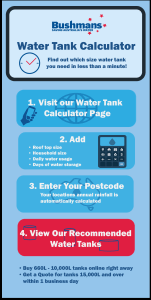
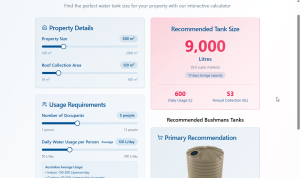
All you need to do is enter a few details such as your postcode, how big your property/roof is, household size and how much water is used per day.
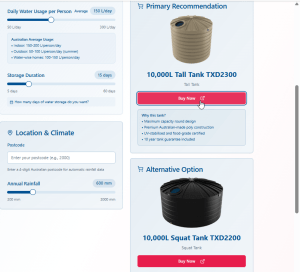
You can also choose how many days of water you want stored. The best part? When you enter your postcode, our water tank calculator will automatically find your local rainfall data, so the results are tailored to your area. Below is a step-by-step guide and information on what each input means.
Step-by-Step Guide
- Add your Property / Roof Collection Area Size – This is the size of the roof area that rain can fall on and be collected into your tank. It’s usually measured in square metres (m²). The bigger your roof area, the more rainwater you can collect. A small roof may only catch a limited amount, while a larger roof can fill a big tank quickly, especially during heavy rainfall. As an average house size, roof sizes are typically between 180-220 square meters.
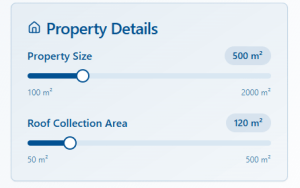
 You don’t need to include your entire property, just the part of your roof connected to the guttering that leads into the tank
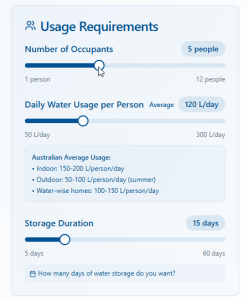
- Include the total number of occupants living in the household/property
- Include the daily water usage per person on average – If you’re unsure, the Australian average daily usage per person is typically around 150-200L.
- Add How many days of Water Storage you need – If you live in a high rainfall area (such as Costal NSW) you’ll likely need fewer days of water storage. In drier regions (such as Inland SA) it is best to allow for more days of water storage to cover longer dry spells.

- Type in your Postcode – As mentioned prior, our water tank calculator automatically adjusts annual rainfall according to your location, so you don’t need to add anything else.
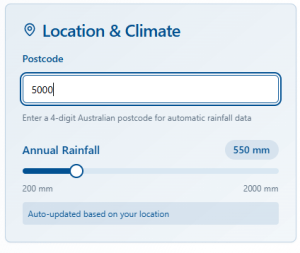

Once you have entered all the relevant details required in our water tank calculator, you’ll be able to see the recommended water tank size based on the information you have given.
Underneath that you’ll see our primary rainwater tank recommendation, and an alternative water tank option in a different tank shape in a similar or same size.
Note: If the tank size is between 660L – 10,000L, you’ll be able to purchase them from our web shop right away too. Handy and convenient.



We’ve also kept our previous water tank calculator on the same page below if you want to also have a play with that.
Tip: More people usually means more water usage—especially for everyday tasks like washing and showering. This helps the calculator estimate how much water you’ll need to store.
Behind The Numbers
The logic behind the calculation can be broken down into simple terms
- Roof area x rainfall = annual harvestable water
- Daily usage x storage days = required storage volume
As a few examples, here’s how the logic behind this water tank calculation is made;
Urban Home (4 people) in a modest rainfall area (600–800 mm/year)
A family of four uses around 600 litres a day. To store 10 days’ worth of water, they’d need a 6,000 litre tank. This size works well in moderate rainfall areas where the tank will refill several times yearly.
The logic behind this calculation can be broken down simply:
Roof area × rainfall = annual harvestable water
For example, a 150 m² roof in a town with 650 mm of rainfall can collect about 97,500 litres a year (150 × 0.65 × 1,000)
Daily usage × storage days = required storage volume
Here, 600 L/day × 10 days = 6,000 litres needed in storage
Example towns:
- Wagga Wagga, NSW (~630 mm/year)
- Ballarat, VIC (~647 mm/year)
- Murray Bridge, SA (~400–600 mm/year, mid-range)
Regional/Rural Area Home (3 people) in a dry area (< 400 mm/year)
Three people use around 450 litres daily. To cover 30 days without rain, you’d need at least a 13,500 litre tank, or multiple tanks to cover the minimum storage required (e.g 2 x 5,000L and 1 x 4,000L, or 1 x 10,000L and 2 x 2,000L ). This size helps manage long dry periods typical in these drier regions.
The logic behind the calculation:
Roof area × rainfall = annual harvestable water
For example, a 200 m² roof in a town with 300 mm of rainfall can collect about 60,000 litres per year (200 × 0.3 × 1,000).
Daily usage × storage days = required storage volume
Here, 450 L/day × 30 days = 13,500 litres needed in storage.
Example towns:
- Port Augusta, SA (~270 mm/year)
- Broken Hill, NSW (~260 mm/year)
- Charleville, QLD (~400 mm/year)
One-Person Household in a High Rainfall Area (1,500+ mm/year)
A single person uses around 150 litres of water per day. In a high rainfall area with frequent rain, storing 3 to 5 days of water is usually enough. That means a tank size of around 450 to 750 litres, which will refill often thanks to the abundant rainfall.
The logic behind the calculation:
Roof area × rainfall = annual harvestable water
For example, a 100 m² roof in a town with 1,200 mm of rainfall can collect about 120,000 litres per year (100 × 1.2 × 1,000).
Daily usage × storage days = required storage volume
Here, 150 L/day × 3 to 5 days = 450 to 750 litres needed in storage.
Example towns:
- Brisbane, QLD (~1,200 mm/year)
- Gosford, NSW (~1,250 mm/year)
- Lakes Entrance, VIC (~1,300 mm/year)
Urban Household (5 people) in a Dry Area (< 400 mm/year)
A household of five uses about 750 litres of water per day. In a dry area with less than 400 mm of rainfall, it’s smart to store 20 to 30 days of water to cover dry spells. That means a tank size between 15,000 and 22,500 litres, ensuring enough water during long periods without rain (e.g, 2 x 10,000L, 1 x 10,000L + 1 x 5,000L, or 1 x 22,500L)
The logic behind the calculation:
Roof area × rainfall = annual harvestable water
For example, a 250 m² roof in a town with 300 mm of rainfall can collect about 75,000 litres per year (250 × 0.3 × 1,000).
Daily usage × storage days = required storage volume
Here, 750 L/day × 20 to 30 days = 15,000 to 22,500 litres needed in storage.
Example towns:
- Mildura, VIC (~285 mm/year
- Whyalla, SA (~277 mm/year)
- Longreach, QLD (~405 mm/year)
- Hillston, NSW (~350 mm/year)
Urban Townhouse (2 people) in a Modest Rainfall Area (600–800 mm/year)
A household of two uses about 300 litres of water per day. To store 7 to 10 days of water, you’d need a tank size between 2,100 and 3,000 litres. This size works well in moderate rainfall areas where tanks refill regularly throughout the year.
The logic behind the calculation:
Roof area × rainfall = annual harvestable water
For example, a 100 m² roof in a town with 650 mm of rainfall can collect about 65,000 litres per year (100 × 0.65 × 1,000).
Daily usage × storage days = required storage volume
Here, 300 L/day × 7 to 10 days = 2,100 to 3,000 litres needed in storage.
Example towns:
- Wagga Wagga, NSW (~630 mm/year)
- Ballarat, VIC (~647 mm/year)
- Murray Bridge, SA (~400–600 mm/year, mid-range)
Regional/Rural Home (4 people) in a Dry to Modest Rainfall Area (400–600 mm/year)
A household of four uses about 600 litres of water per day. To store 15 to 20 days of water, you’d need a tank size between 9,000 and 12,000 litres. This size helps manage water supply during dry spells common in these regions.
The logic behind the calculation:
Roof area × rainfall = annual harvestable water
For example, a 180 m² roof in a town with 500 mm of rainfall can collect about 90,000 litres per year (180 × 0.5 × 1,000).
Daily usage × storage days = required storage volume
Here, 600 L/day × 15 to 20 days = 9,000 to 12,000 litres needed in storage.
Example towns:
- Tamworth, NSW (~530 mm/year)
- Horsham, VIC (~430 mm/year)
- Clare, SA (~525 mm/year)
- Kingaroy, QLD (~600 mm/year)
Tank Types & Sizes
Here at Bushmans, we’re aware that there are a variety of factors, limitations and space capacity for each Australian home, property and business. As per the examples above, our water tank calculator will determine the best recommended option based on your input, and an alternative option close to similar sizing or in a different tank shape.
We know that not one shape or size fits all, which is why we offer our poly tanks in a variety from 660L – 46,400L in;
- Slimline Tanks – Long and narrow, shaped to hug a wall or fence. Ideal for narrow spaces like the side of the house, carport or shed
- Modular Slimlines – More cylindrical shaped with softer rounded edges. Best for spaces with limited access of space
- Domed Squat Tanks – Short and wide with a rounded dome top. Perfect for storing under areas like windows or trees
- Tall Tanks – Taller, straight-sided tanks with a smaller footprint. Ideal for smaller yards where vertical space is available, but ground space is limited
- Domed Tall Tanks – Similar to tall tanks, but with a rounded dome top. Ideal for areas where you want maximum capacity in a minimal ground area
- Domed Round Tanks – A classic wide round shape with a domed lid. Best for farms, acreages or larger spaces where space isn’t an issue, and maximum storage is the goal
- Underdeck Tanks – Flat and rectangular shaped, designed to fit under decks or floors. An ideal solution if outdoor tank space is limited, or if you want the tank hidden
Our Aqualine Steel Tank range (made from galvanised steel) ranges from 20,000L to 360,000L. These Steel Tanks are more ideal for large rural properties, farms or commercial settings. Our Steel Tank Shapes;
- Smaller Capacities (20,000L – 80,000L): More compact and rounded in shape, ideal for tighter spaces
- Larger Capacities (100,000L – 360,000L): Wider with flatter tops for maximum storage
Save On Money and Water Usage with Bushmans
With all that information at the palm of your hand, it’s time to put it into action. Go on, give our water tank calculator a try by clicking here! Send it to family, friends or co-workers, and try your own set up in just a few clicks – you never know when you might need it again. Feel free to pin the water tank calculator page on your phone, or save it as a bookmark on your computer.
With 5 facilities across 4 states, our water tank calculator is bound to help you find the water tank you’re looking for.
- Poly Rainwater Tanks 660L – 2,600L
- Poly Rainwater Tanks 3,000L – 15,000L
- Poly Rainwater Tanks 22,500L – 46,400L
- Aqualine Steel Liner Tanks 20,000L – 280,000L
- Aqualine Steel Liner Tanks 320,000L – 360,000L
- Poly Round Rainwater Tanks 1,000L – 47,300L (NQ Only)
- Poly Slimline Rainwater Tanks 2,000L – 5,000L (NQ Only)
Whether you know which rainwater tank you need or if you need some guidance, we’re here to help. You can contact us by filling out our contact form here or by calling us on 1800 287 462. Don’t delay, get started on your water savings today!
Related Blogs