In early 2025, Queensland faced some of the worst flooding seen in decades. Vast parts of the Channel Country were transformed as record-breaking rainfall inundated more than 13 million hectares of land, turning dry floodplains into vast inland waterways (ABC News, 2025). Floodwaters stretched across an area larger than France and Germany combined, with entire towns cut off and over 150,000 livestock lost—making it one of the most widespread flood events in Australian history (The Guardian, 2025). These events have reminded homeowners and farmers alike that when the rain does come, it can come hard—and managing stormwater is no longer a choice, but a necessity.
As extreme weather becomes more frequent, having the right infrastructure in place can help reduce localised flooding and protect homes, farms, and communities. Rainwater tanks, especially when installed with proper overflow systems, play a key role in stormwater control. Whether you’re in rural Queensland or along the east coast, preparing for future rainfall events starts now.
Queensland’s Record Rainfall and Flooding in 2025
The Bureau of Meteorology (BOM) reported that Queensland’s area-averaged rainfall total for May was 20.1 mm—35 % below average—but this followed months of intense rainfall across the state (BOM, 2025). In late March, parts of outback Queensland recorded over 400 mm of rain in a single week, which led to widespread flooding in towns like Thargomindah, Windorah, and Quilpie (ABC News, 2025; NASA Earth Observatory, 2025).
The Guardian described this inland flood as one of the largest in Australian history, with dry river systems such as Cooper Creek and the Diamantina reaching levels not seen since 1974 (The Guardian, 2025). Satellite imagery captured by NASA and reported by ABC News showed floodwaters spreading across more than one million square kilometres, flowing into Kati Thanda–Lake Eyre and transforming the arid interior into temporary wetlands (ABC News, 2025).
While the ecological benefits of such flooding are real, the destruction left behind for property owners—especially those unprepared—has been significant.

 Queensland Floods: How to Use Rainwater Tanks to Manage Overflow and Protect Your Property
How Rainwater Tanks Help Manage Flooding
Rainwater tanks are more than just water storage solutions—they’re part of a practical approach to stormwater management. When used effectively, tanks can help reduce surface runoff during heavy rainfall, slowing the flow of water into drains, creeks, and low-lying areas. For flood-prone parts of Queensland, this can reduce the risk of water pooling around foundations, flooding sheds, or overwhelming property drainage systems.
Overflow Systems and First-Flush Diverters
During intense downpours, a rainwater tank can fill quickly. That’s where a rainwater overflow system becomes important. These systems safely redirect excess water away from buildings and into designated stormwater drains or dispersal areas. Without one, tanks can overflow around the base, leading to erosion, water damage, or tank movement.
A first flush diverter system adds another layer of protection, especially in rural areas. These devices capture the initial flow of dirty, debris-laden rainwater from rooftops before it enters the tank, helping maintain water quality and keeping sediment out of the system.
Both of these components work together to support safer, more efficient stormwater management on your property.
Bigger Tanks, Better Protection
During long dry spells, smaller tanks may be sufficient for garden use or limited farm needs. But when dealing with intense and repeated downpours, large capacity rainwater tanks provide greater buffer storage and delay the release of stormwater back into the environment.
For example, if a farm in Central Queensland receives 100 mm of rain in a single day (as many did during the March floods), a single 22,500L tank connected to a 200m² roof can capture over 90% of that rainfall. Multiply this across multiple tanks and structures, and you’re holding back thousands of litres of water from flowing across the ground all at once.
For farmers, this helps preserve topsoil and reduce runoff across paddocks. For homeowners, it helps reduce pooling around driveways, sheds, and the home’s perimeter.
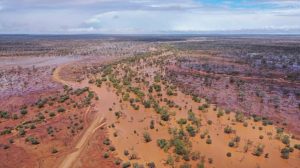
 Image Source: ABC NEWS
From heatwaves to monsoonal rain, cyclones and flooding, Australia’s severe weather just keeps unfolding. Authorities are urging Aussies to have a flood plan.Tips for Flood-Resilient Tank Installation
Choosing flood-resilient water tanks is only one part of the equation—installation is just as important.
Here are some practical rainwater tank installation tips for flood-prone areas:
- Elevate the tank pad: Install tanks on a raised concrete or compacted gravel base to reduce the risk of flooding at the base and to keep fittings above surface water.
- Secure with tank restraints: Especially important for slimline or tall tanks, anchoring systems prevent tanks from shifting during water surge events.
- Install drainage diversion: Ensure overflow pipes direct water away from buildings and onto grassed or gravel areas where it can soak in safely.
- Consider underground tanks: For properties with limited space or high fire risk, underground tanks offer protection from flood damage and temperature extremes.
These measures help ensure your tank not only functions during a flood event, but also stays exactly where you put it.

 Image Source: MLA
Knowing how to use your rainwater tank and managing your overflows can help prevent further damage to your property.Planning for the Next Rainfall Event
While Queensland’s weather is unpredictable, heavy seasonal rainfall is becoming increasingly common. In May 2025, a Mother’s Day weekend storm brought more rain and strong winds to the east coast, from the Whitsundays down to the Gold Coast. Marine warnings and road closures followed as already-saturated catchments struggled to cope.
Whether you’re in the outback or along the coastal fringe, it’s clear that stormwater management tanks are no longer a “nice to have”— they’re an essential investment in protecting your property from weather extremes.
Bushman Tanks has been helping Australians manage their water for over 30 years. Our range of flood water control tanks and rainwater tanks in Queensland includes models suited for homes, farms, sheds, and commercial properties—all designed with overflow management in mind. And with decades of experience in rural stormwater solutions, we understand what works in a Queensland climate.
References
ABC News. (2025, May 14). Channel Country transforms after record-breaking flooding in outback Queensland. https://www.abc.net.au/news/2025-05-14/channel-country-transforms-after-record-breaking-flooding/105274426
Bureau of Meteorology. (2025, May). Queensland monthly climate summary – May 2025. http://www.bom.gov.au/climate/current/month/qld/summary.shtml
NASA Earth Observatory. (2025, April 2). Floodwaters surge through the Australian outback. https://earthobservatory.nasa.gov/images/154116/floodwaters-surge-through-the-australian-outback
Readfearn, G. (2025, April 6). How historic is what we’re seeing in the Queensland floods? It’s hard to grasp the full magnitude. The Guardian. https://www.theguardian.com/environment/2025/apr/06/how-historic-is-what-were-seeing-in-the-queensland-floods-its-hard-to-grasp-the-full-magnitude