Overflowing With High Prices & Rapid Climate Change
As the cost of living continues to surge, so does the future of climate change and sustainability on a national, and global scale. The trajectory for Australia’s climate alone is predicted to continue to decrease in average rainfall, and rise in temperature.
Though different areas of the country are more prone to particular weather climate events, such as Southern Australia being more prone to droughts and Eastern Australia more vulnerable to flooding, climate change impacts the entire country.

 Australian rainfall deciles from 2024 SOURCE: BOM
Severe droughts, fires, floods and heavy rainfall plague the country simultaneously, with no signs of slowing down. Damage to ecosystems, water resources and agricultural sectors are hit hard, causing a ripple effect both environmentally, and economically across Australia.
Due to the impact of climate change, prices have risen in sectors such as energy (water & electricity), food (groceries) and insurance policies (housing). It’s no wonder why so many Aussies are turning to the likes of rainwater tanks as a solution to reduce costs, and to cope with the climates impact.
With that being said, you may be wondering how a water tank can help save money. Have you just bought a house and want to reduce costs? Are you living in a dry or wet area? Not sure what you can use a water tank for? Regardless, in this blog we’ll help you understand the uses and benefits, plus how much you can potentially save in water bill costs with a water tank.
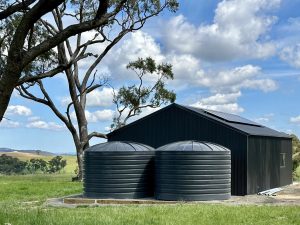
 An example of two tanks being used for outdoor use
How Do Water Tanks Work And What Can I Use Them For?
Water tanks, also known as rainwater tanks, are typically connected via a downpipe from a roof that then flows into the tanks inlet, and into the tank. It is completely up to you whether or not you prefer to plumb the tanks as your main water source, or if you prefer to use them for outdoor purposes only.
Water tanks are multi purpose and you can use them for everyday essentials such as;
- Washing machines
- Toilets
- Gardening / outdoor use
- Sinks
- Showers / baths
On top of that, you can also use a water tank to help prepare in the event of;
- Droughts
- Heatwaves
- Flooding
- Heavy rainfall
- Power outages
- Water system outages
As you can already tell, there’s quite a few uses a rainwater tank can provide around your home, business or property. Above are just some examples of how you can use a water tank, and the benefits of these uses impact you, the environment and the people around you for the better. All because of a rainwater tank. Here’s how it will benefit you;
The Benefits Of A Water Tank
Saving Money
By using a rainwater tank instead of relying on your main water supply, you could be saving anywhere from a hundred, to hundreds of dollars a year on your water bills. With the cost of living surging and impacting many Australians, saving where you can has become more crucial, especially among those with a mortgage, farm or small business. Whether you plan to use your rainwater tank for most of your water needs or just for some, every bit counts and makes an impact.
On top of that with careful planning, management and circumstances, you can reduce your water bill costs even further. As an example, if you are living in an area with heavy rainfall and have a large tank or multiple large tanks, you would be able to store more rainwater, and therefore reduce using your main water supply.
The initial investment of a tank up front can be significant, but in the long-term the water tank will be saving you thousands of dollars throughout the years – more often than not, much more than the cost of the tank itself.
Regardless if it is for your home, business or property, using a rainwater tank instead eases the pressure off water infrastructure systems. This in turn means reducing your water usage, which is the next benefit.
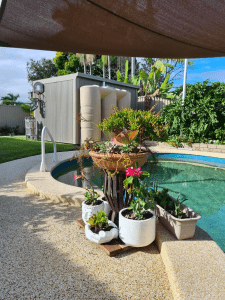
 How easily a Slimline Tank can fit into your limited space
Reducing Water Usage
While you’re saving on money, you’re also helping the environment and other people, particularly in agriculture sectors, by reducing your water usage. By doing this, you’re helping to conserve energy, which means lower greenhouse gas emissions.
Protecting aquatic ecosystems and preserving essential water resources is also crucial in protecting declining habitats, and preventing water shortages in the event of a drought.
Easing pressure off water infrastructure systems also reduces the demand on water treatment plants, stormwater systems and pipe networks, reducing the risk of these systems breaking down or being overloaded.
Ease of Water Restrictions
With the use of water tanks, they can help reduce or alleviate the need for water restrictions altogether. Whether it’s in your area, city or state, having less pressure on municipal sources during dry periods as an example, can help communities in areas more prone to water scarcity maintain essential water use, and protect local ecosystems. Particularly in rural or remote areas where regional water systems are limited.
Flood and Drought Security
Having a rainwater tank helps reduce flooding by capturing and storing rainwater that would otherwise flow off rooftops and into stormwater drains. During heavier rainfall, this excess water can overwhelm these drainage systems, which can then contribute to localised flooding, erosion, and even pollution seeping in waterways.
By holding back some of that rainwater in a tank, this reduces the pressure off water infrastructure systems, and reduces the risk of flash flooding.
With a rainwater tank, this can improve drought security by providing a backup water source supply when rain is scarce, and/or if main waters are restricted. By storing water during the wetter seasons (such as with heavy rainfall periods) households and farms can continue with the essentials without needing to rely on main water systems heavily, or at all in some cases.
With just a few examples of the benefits you’ll gain above, it seems like a practical investment and an undeniably beneficial solution. So the next question is – how much money can you save with a water tank?
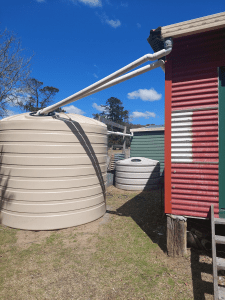
 How most tanks are connected via pipe from the roof and into the tanks inlet
How Much Money Can You Save With A Water Tank?
From Canstar Blue’s survey conducted in 2024, research showed that the average Australian household typically spends figures around $800 – $1000 per year, or between $200 – $250 per quarter on water bills. These figures of course vary as it can depend on several factors such as location, rainfall, household size and usage.
As per this survey, Canstar Blue research showed an average price of water bills depending on number of household occupants;
- 1 person household – $158 per quarter or $632 per year
- 2 person household – $220 per quarter or $880 per year
- 3 person household – $228 per quarter or $912 per year
- 4 + person household – $254 per quarter, or $1,016 per year
Using these figures above as a rough guide, according to YourHome.gov, using rainwater tanks can save you anywhere between $200 to $800 per year, depending on how the tank is used, rainfall conditions and other factors at play. As an example if you are living in a household with 4+ people or more, you could have your water bill reduced to under $1000, or if you’re living solo you could cut your cost under $600.
There are a few other things to consider when choosing the right rainwater tank size for your circumstances. You’ll need to consider things like;
- Space you can fit the tank
- What you want to use the tank for
- If you need a slimline or domed squat shaped tank
- How many tanks you require
Bushmans has made this handy water tank calculator that you can use here to get a bit of an idea of which tank size and shape matches your needs and requirements.
As a guide, we’ve also put together a few examples of what size tank may be relevant for you based on circumstances;
Tanks In High-Rainfall Areas
If you are living in an area such as coastal QLD or northern NSW, a large tank would be more beneficial to keep up with storing rainwater all year round, and to avoid overflow. Depending on your household size and what you want to use the tank for as well, ideally any tank that can hold 10,000L or more is a likely ideal solution for your water saving costs.
Tanks in Low-Rainfall / Drought-Prone Areas
Multiple smaller tanks can be a more practical and resilient choice for those living in areas prone to droughts, such as rural homes, inland SA or Western NSW. If you are a smaller household or are using the tanks water for essential uses, 2,000L – 5,000L tanks may be the best option for these circumstances.
Tanks in Moderate-Rainfall Areas / Metro & Surrounds Housing
Medium sized tanks between 3,000L – 10,000L are the most common size tank capacities found in modern homes. Especially with the likes of townhouses or units where space is limited or shared, this is where slimline shape tanks are commonly utilised. In areas like Melbourne, Adelaide or Canberra where rain is average or below average, the ideal tank for your water storage solution could be a medium sized slimline or domed squat tank.

 You can choose from an assortment of colours to match your space. Save water in style!
While rainwater will save you money as you’re not paying for it, it is important however, to still think about ways to reduce water waste further – even with a tank. You can do this by reducing on the little things, such as;
- Turning the tap off when you’re brushing your teeth
- Using the dishwasher or washing machine only when there’s a full load
- Washing your car or pets on the lawn instead of the pavement
- Fixing leaks and drippy taps as soon as possible
- Using mulch in your garden
- Watering the lawn/garden in the early morning or late evening
Small things like these actions can make your rainwater tank usage even more efficient, and can help if you still need to or still intend to use the water main supply.
Save On Water Bills And Protect The Environment With Bushmans
With infrastructure upgrades, population growth, and water security on the horizon set to impact many regions across Australia, the cost of living is expected to increase. This includes the essentials such as water bills and everyday utilities.
Bushmans offers a wide range of rainwater tanks that can help reduce cost on your water bills, and to cope with Australia’s climate.
- Poly Rainwater Tanks 660L – 2,600L
- Poly Rainwater Tanks 3,000L – 15,000L
- Poly Rainwater Tanks 22,500L – 46,400L
- Aqualine Steel Liner Tanks 20,000L – 360,000L
- Poly Round Rainwater Tanks 1,000L – 47,300L (NQ Only)
- Poly Slimline Rainwater Tanks 2,000L – 5,000L (NQ Only)
Whether you know which rainwater tank you need or if you need some guidance, we’re here to help. You can contact us by filling out our contact form here or by calling us on 1800 287 462. Don’t delay, get started on your water savings today!
Related Blogs