Retention and detention systems are stormwater tanks that store runoff and control how it’s released, helping prevent flooding and protecting drainage infrastructure.
Australia’s cities are now generating far more stormwater runoff than their drainage systems were originally designed to manage. Research of stormwater in Australia shows that urban areas produce up to 90% more runoff than natural landscapes, and major cities generate an estimated 3,000 gigalitres of stormwater each year. This rapid increase in runoff is one of the key reasons why councils mandate on-site detention and retention systems for new developments.

What Is a Detention System?
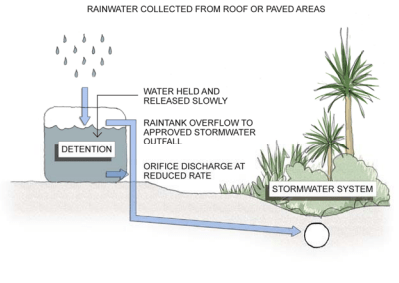
A detention system is designed to temporarily hold stormwater and release it back into the drainage system at a slow, controlled rate. It does not store water for reuse, its sole purpose is to manage runoff and protect public drainage systems.
Detention systems are commonly required for:
- New commercial and industrial developments
- Multi-unit residential builds
- Subdivisions and dual occupancies
- Sites with increased hard surfaces
- Car parks, sports courts and large roof areas
How Do Detention Systems Work?
During heavy rain, water enters the detention tank through an inlet. Inside the tank, water is briefly stored and then released through a slow-release orifice sized to meet council discharge requirements. This ensures the tank continually empties, making it ready for repeated storm bursts.
Detention systems prevent:
- Peak flows overwhelming drains
- Local flooding
- Erosion and infrastructure damage
What Is a Retention System?
A retention system stores stormwater on-site for future use. This stored water can be used for:
- Garden irrigation
- Toilet flushing
- Washing vehicles or equipment
- Laundry use
- Industrial processes (non-potable)
Retention tanks help reduce demand on mains water and support sustainability initiatives across residential, industrial and commercial sites.
How Do Retention Systems Work?
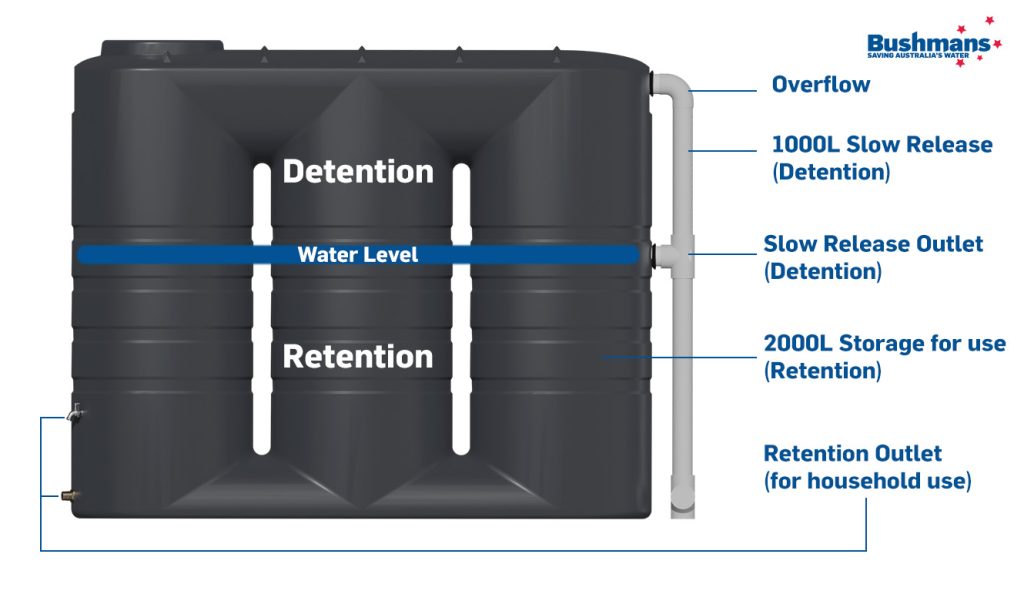
Retention tanks store water below the outlet level, allowing you to draw on this supply whenever needed. Any water above the outlet level functions as detention storage, meaning a single tank can serve both purposes.

Retention Tanks vs Detention Tanks
Although retention and detention tanks are often discussed together, they perform very different roles in stormwater management. The table below highlights the key differences between retention and detention tanks.
Feature | Stormwater Detention | Stormwater Retention |
Purpose | Temporarily hold water, slowly release to drains | Keep water on-site for reuse |
Water Reuse | No | Yes – non-potable uses |
Regulatory Requirement | Often mandatory | Recommended for sustainability |
Impact on Drainage | Reduces peak flows | Reduces reliance on mains water |
| Ideal For | Flood mitigation, council compliance | Water savings, irrigation, and household use |
Many developments now use a hybrid system that combines both functions within a single tank.
The Importance of Retention/Detention Systems
Due to the changing climate Australia has seen abnormal weather conditions and high rain fall. This has resulted in unprecedented flooding in parts of Australia that are not usually subject to severe flooding. Councils have the responsibility to plan and develop their water systems capacity but as the population grows and weather patterns change the existing water infrastructure needs to adapt to these changes. This is where retention and detention systems play a crucial role.
- Flood prevention: flood retention tanks reduce sudden surges of runoff entering the drainage network, helping protect homes, businesses and public infrastructure during heavy rainfall events.
- Protecting drainage infrastructure: By releasing stormwater at a controlled rate, these systems prevent drainage pipes from being overwhelmed, reducing the risk of blockages, erosion and costly damage to downstream assets.
- Environmental and water-quality benefits: Stormwater systems improve water quality by:
- capturing sediment, debris and pollutants carried by runoff
- reducing erosion around creeks, drains and natural waterways
- supporting healthier local ecosystems during extreme weather
- Water conservation and reuse: Retention tanks store water that would otherwise be lost. This provides a reliable non-potable supply for gardens, toilets, equipment washing and industrial processes, improving water security, especially in drought-affected regions.
- Supporting council compliance: Most councils now require stormwater management systems for new developments or increases in hard surfaces. Installing the correct detention or retention system reduces approval delays and ensures your project meets local stormwater regulations.
Below is a table that shows how the use of water tanks can contribute to minimising the stormwater runoff, flooding, and have environmental impacts.
Solution | Usability | Impact |
| Home water tanks | - Around the house and garden
| - Cut down on water costs
- Minimise flooding because water tanks hold and slowly release stormwater once full
|
| Farming water tanks | - Irrigation
- Livestock watering systems
- Stock and domestic water systems
| - Water conservation
- Maintain healthy farm population
- Cut down on water costs
- Reduces the pressure on local rivers
|
| Industrial water and Chemical tanks | - Cooling water
- Washing down
- Food production
- Cleaning
- Chemicals can be managed on site and without leakage due the use of polyethylene plastic
- Storing oil, sludge, fuel
| - Cut down on water costs
- Secure chemicals are not released to the environment
- Because they are custom-manufactured, we can reduce raw material waste (polyethylene plastic)
|
Do You Need a Detention or Retention System?
Rainwater tanks have been mandated in several states where homes, farms, industrial and commercial developments need to have rainwater tanks installed on site.
Residential Properties
Residential stormwater detention system may be required if you’re:
- Building a new home
- Extending your home
- Adding hard surfaces (driveways, patios, sheds)
- Developing dual occupancy lots
Retention is often recommended, even when not required, to help households reduce mains water use.
Commercial & Industrial Sites
Detention systems are frequently mandatory in commercial and industrial sites due to large roof areas, car parks and high impermeable surface coverage.
Council Mandates and Development Triggers
Requirements vary by state and council. Some councils allow a swimming pool or larger rainwater tank to substitute detention; others strictly require a dedicated system. Always confirm local requirements early in the design process.
Choosing the Right System for Your Property
- Site & Space Requirements: Consider site slope, access, available footprint and location of stormwater connections.
- Capacity & Catchment: Tanks must be sized according to:
- Roof area
- Local rainfall intensity
- Council discharge rate
- Required retention volume
- Soil & Installation Conditions: Ground stability and excavation depth affect installation choices—particularly for large or industrial sites.
- Materials, Durability & Maintenance: Bushmans’ UV-stabilised Sunsmart® polyethylene, food-grade materials, and robust fittings provide long-term reliability with minimal maintenance needs.
Bushmans water tank specialists make it easy and help guide the purchase and installation of a rainwater tank to meet council requirements.
Bushmans provides Australia with high-quality and value-for-money water and liquid storage tanks and related products. Our extensive range of products for sale includes quality water storage solutions and tank accessories for a variety of different applications in rural, industrial and urban settings.
From small to large, poly tanks to steel, Bushmans manufactures an immense range of water tank sizes and solutions for agricultural, industrial, and residential use. Our Poly water tanks for sale range in size from 1,000 litres to 46,400 litres. Slimline water tanks are ideal for locations where space is tight. Bushmans Aqualine steel water tanks range in size from 20,000 litres through to 360,000 litres. In addition to water tanks, Bushmans also offers water tank fittings, pumps, and accessories for sale, as well as a large selection of agricultural products, such as troughs and feeders.
Bushmans products are built to withstand the demands of daily use and the harsh Australian climate. If you are interested in enquiring about a quality water tank, give Bushmans a call on 1800 008 888 or fill out a contact form and one of our friendly tank specialists will be in touch.